
Information about IVDD
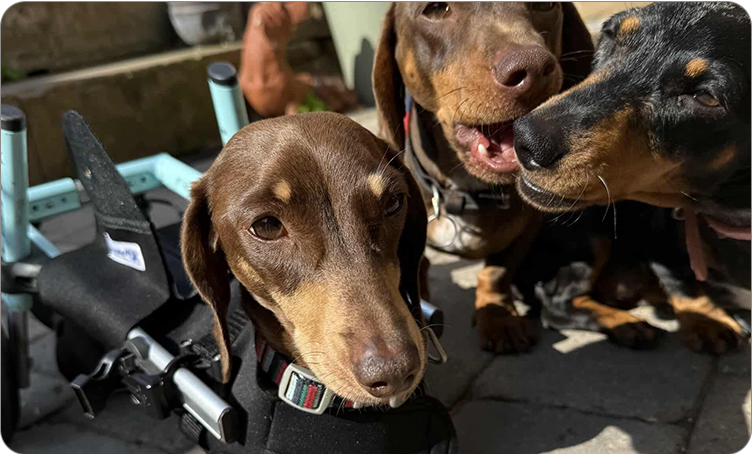
When your pet has IVDD symptoms you will have a lot of questions - this page aims to help guide you with some answers to those most frequently asked questions.
IVDD is intervertebral disc disease. This condition affects around 1 in 4 dachshunds. A first episode is most likely to happen between the ages of 4 and 7.
In the dog suffering from IVDD, the discs that sit between the vertebrae of the spine bulge or burst into the spinal cord space.
SYMPTOMS
The symptoms of IVDD are varied and all dogs differ in the way they present, ranging from mild pain, wobbly legs, difficulty walking to paralysis. Dogs with severe IVDD may be unable to move their legs at all (paralysis) and may lose control of bladder and bowel function If your dog is starting to show signs of IVDD then he should be checked by a vet promptly. Most cases will need prescribed medication including painkillers, plus confinement to a non-slip pen or crate to reduce risk of further injury.
It's really important that your dog gets the right diagnosis, quickly. In a survey among Dachshund owners on our Facebook Group, only half the IVDD cases were correctly diagnosed by their general practice vet on first presentation. Shockingly, a quarter of vets incorrectly diagnosed the problem, for example saying it was muscle pain, arthritis or a stomach problem. Some dogs have presented with anal gland problems which the vet may empty but the underlying pain, due to IVDD, remains. A further quarter of vets were unsure about the symptoms at first examination.
SIGNS OF PAIN REPORTED IN IVDD-AFFECTED DACHSHUNDS
Difficulty walking, jumping up or standing upright on their hind legs
Crying or flinching when touched
Trembling, shaking and/or panting
Arched back
Crying or yelping when picked up
Refusal to go down a small step or kerb
Change of mood or temperament
Swollen or hard abdomen
Reduced appetite
Unable to do a full body shake
For further information visit https://www.dachshund-ivdd.uk/symptoms-treatment/ and also http://therehabvet.com/2017/10/ivdd-diagnosis-in-dogs/
IVDD often strikes without warning and can be a very worrying and stressful time. Having a list of what to ask your vet can help you remember the important questions you need to ask.
https://www.dachshund-ivdd.uk/symptoms-treatment/clinical-diagnosis/questions-to-ask-your-vet/
IVDD clinical grading is the way your vet assesses your dog’s condition, there are 5 grades with 1 being the mildest and 5 the most severe. The grading also helps your vet recommend the best course of treatment.
HOME CARE
The link below includes information on treatment options, more specific home care requirements, problems to watch out for, and a typical timescale of recovery.
Grade 1-2
If your dog is able to walk either normally or with a wobble (grade 1 or 2) then click here
https://therehabvet.com/2017/10/ivdd-dogs-who-can-walk/
Grade 3-4
If your dog cannot walk without help (grade 3 or 4) then click here
https://therehabvet.com/2017/10/ivdd-grades-3-and-4/
Grade 5
If your dog is unable to walk and your vet has also told you that he is so severely-affected that he has “no deep pain” (grade 5) then click here
https://therehabvet.com/2017/10/ivdd-dogs-with-no-deep-pain/
CONSERVATIVE TREATMENT
Conservative (non-surgical) treatment may be recommended by the vet when surgery is not considered necessary or may not be affordable. It involves medication, walk retraining, and strict use of a pen or crate to prevent exuberant activity. The pen or crate is typically needed for a period of at least 6 to 8 weeks.
I try to avoid the term “strict crate rest” as many people think this means being imprisoned in a very tiny crate for 23.5 hours of the day and then let outdoors off-lead for toileting. We do want the dog to do some on-lead assisted walking during recovery, and this is typically built up during the “crate rest” period.
For further information visit these links:
http://therehabvet.com/2017/09/ivdd-non-surgical-treatment/
https://www.dachshund-ivdd.uk/symptoms-treatment/conservative-treatment/
Exciting news from Cambridge IVDD Research Group has shown that conservative (non surgical) treatment can be just as affective as surgery for all grades. See information and video links below.
Cambridge IVDD Research Group - Cambridge Research IVDD Facebook Page
My Dachshund has IVDD… What Now? Cambridge Video
The Facts and Fears Webinar Cambridge / KC IVDD Webinar
SURGICAL TREATMENT
Surgical treatment may be recommended by the referral specialist and often follows on from an MRI or CT scan, The dog remains at the vet hospital for a period of time before returning home to crate rest with medication and limited walks for approximately 6 weeks.
The length of time it takes for dogs to recover following surgery but can be different for every dog and is dependent on several factors.
Click here for further information: https://www.dachshund-ivdd.uk/symptoms-treatment/surgical-treatment/
NEW ENZYME INJECTION TREATMENT
A new enzyme injection treatment for dogs with severe intervertebral disc disease (IVDD) is now available at the Queen’s Veterinary School Hospital (QVSH), offering a safe, less invasive, and more affordable alternative to surgery for some patients.
It is also available at the Texas A&M University who also conducted the trial alongside Cambridge University.
Please click the link for further information of this treatment:
These vet and referral centres are the ones recommended by UK owners; a referral can only be made by your own vet so always consult with them first.
https://www.dachshund-ivdd.uk/uk-resources/veterinary-referral-practices/
Dedicated to Dachshunds has gathered information for Fixed Price or Prices of £6K and under for IVDD Surgery across the UK. Note: Owners will need to call up as prices may change.
Visit the link below for a detailed list.
To encourage breeding of dogs with a lower risk of IVDD, dachshunds between the ages of 2 and 4 can be X-rayed through the UK screening scheme. The X-ray shows any calcification of the discs. Dogs with many calcifications have been shown to be more at risk of IVDD, and of passing the condition on to their offspring.
equipment loan

symptoms of IVDD

recovery from IVDD
