
Caring for Your IVDD Dog

It's a scary and upsetting experience when your dog comes down with IVDD and, whether they have had surgery or need crate rest, the same problems can apply. Here are some commonly asked questions about coping with your recovering dog and don't forget to look at our equipment loan page to see what we can help you with.
Home Care During IVDD Recovery
A crate or pen is usually needed to help keep your dog safe following on from surgery or during conservative treatment. You may need to support your dog with a sling during early attempts at walking. You dog may also need help in keeping clean and assistance with toileting.
These links give approved advice to help you manage your IVDD dachshund at home:
Choosing a crate or pen
Where to put the recovery crate or pen
Bedding in the crate or pen
Using a sling
Going outdoors without a sling
During recovery walk them SLOWLY with SUPPORT and with a HARNESS and LEAD to SLOW them down. This will help their back legs to work, instead of dragging themselves forwards with their front legs. Give gentle massage over muscles and joints.
Coming to a stop encourages the weight to be taken naturally on the back legs and will help strengthen the muscles. Help them to stand whilst supporting them. Use a harness and lead to slow down your recovering dog whenever outdoors. Slowing down your dog’s front end will give the hind paws a chance to “catch up” and to learn to walk again. For dogs that cannot walk, use a hindquarter sling with just enough lift to prevent the hind paws from dragging and getting damaged.
Whenever they are outside the recovery pen, he should be in your arms or on a harness and lead.
If you can….On non-slip matting, spend a little time using your hands and the dog’s harness to support him safely in natural dog postures…standing with support, sitting with support, and laying down. Take care….don’t let your dog fall! Use your hands as guides and gentle supports. Your dog’s muscles will fatigue quickly. Encourage lots of rest between attempts at standing, etc.
Only do massage if your dog is comfortable with it. Given a good recovery pen, good sling-walking, and some help practising natural postures, dogs can get better without any massage, range of movement or other touch work. For IVDD dogs, massage is always gentle and careful…generally a stroking type of pressure rather than kneading…In addition to massage, your physio may also teach you to do “range of movement” (gently guiding the legs so that the joints fold a little and then extend) and sensory touch work (including gentle touches to help “switch on” some key muscles).
SLING WALKING
https://therehabvet.com/2017/10/ivdd-sling-walking/
WALKING YOUR RECOVERING DOG
https://therehabvet.com/2017/05/walking-with-your-recovering-dog/
IVDD DOGS WHO CAN WALK
https://therehabvet.com/2017/10/ivdd-dogs-who-can-walk/
IMPORTANT RECOVERY EXERCISE- BELLA GRADE 5 (LICKIMATT)
https://m.facebook.com/story.php?story_fbid=1494747337386072&id=332713093589508
PHYSIOTHERAPY TECHNIQUES – MARNIE
https://www.facebook.com/332713093589508/posts/1480020698858736/
MARNIE PART 2
https://www.facebook.com/332713093589508/posts/1499310790263060/
MARNIE PART 3
https://www.facebook.com/332713093589508/posts/1515819908612148/
CRATE REST- DAILY ROUTINE
https://therehabvet.com/2017/03/crate-rest-daily-routine/
RECOVERING DOG- ADVICE FOR OWNERS
https://therehabvet.com/recovering-dogs-advice-for-owners/
Many dogs get distressed when they are in the confinement of a crate or pen, especially those that aren’t crate trained. It is essential for their recovery that they remain confined to ensure that they don’t injure themselves by running around and jumping.
Owning a dachshund involves adopting a lifestyle to help keep them fit and healthy through all their life stages and to help reduce the risk of IVDD.
Each dog should be fed a well-balanced diet designed for his or her life stage. To keep the dog at an ideal weight, it is important to measure out the amount of food offered each day. Your vet can advise you on your dog’s ideal weight and diet. Supplements are generally not needed if a balanced diet is fed.
https://www.dachshund-ivdd.uk/lifestyle-advice/diet-supplements/
During recovery from IVDD, any outdoor activity will need to be slow and on the lead. A walking harness offers more support and safe control than a neck collar during recovery.
Neutering is not recommended until the dog/bitch is a minimum of 12 months old as there are higher instances of dogs developing IVDD that were neutered before 12 months of age.
Dachshunds are notoriously known for launching themselves into fresh air, but sensible precautions should be taken to reduce the risk of shock injuries causing IVDD incidents.
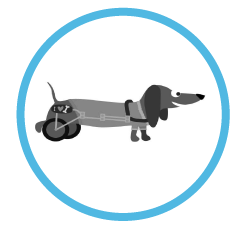
Wheels are best reserved for those dogs who are still unable to walk on their own after months of owner-assisted walking. Once the dog relies on wheels to get about, he is less likely to go on to make the effort to relearn to walk on his own. Sling-walking, supported standing, provision of non-slip flooring and walk-retraining with guidance from a physiotherapist are all recommended before resorting to wheels.
equipment loan

symptoms of IVDD

recovery from IVDD
